Kitchen Tools review
Kitchen Scales Compared: Escali Digital, Glass and Dial
Four Escali scales, three designs and one clear split: big capacity, fine readout or no batteries at all.
The short version
Escali
Escali Primo Digital Scale
We recommend4.6 (7,424 ratings)
- Best for everyday baking and portioning on a small counter
- Skip it if you want a backlight or a hold function for huge bowls.
Escali
Escali Arti Glass Scale
Recommended, with caveats4.3 (1,578 ratings)
- Best for bakers who weigh into large mixing bowls
- Skip it if slow tare or a screwed-in battery door would annoy you.
Escali
Escali Mercado Dial Scale
Recommended, with caveats4.4 (418 ratings)
- Best for rough portions and a battery-free retro look
- Skip it if you weigh grams of yeast or spice for baking.
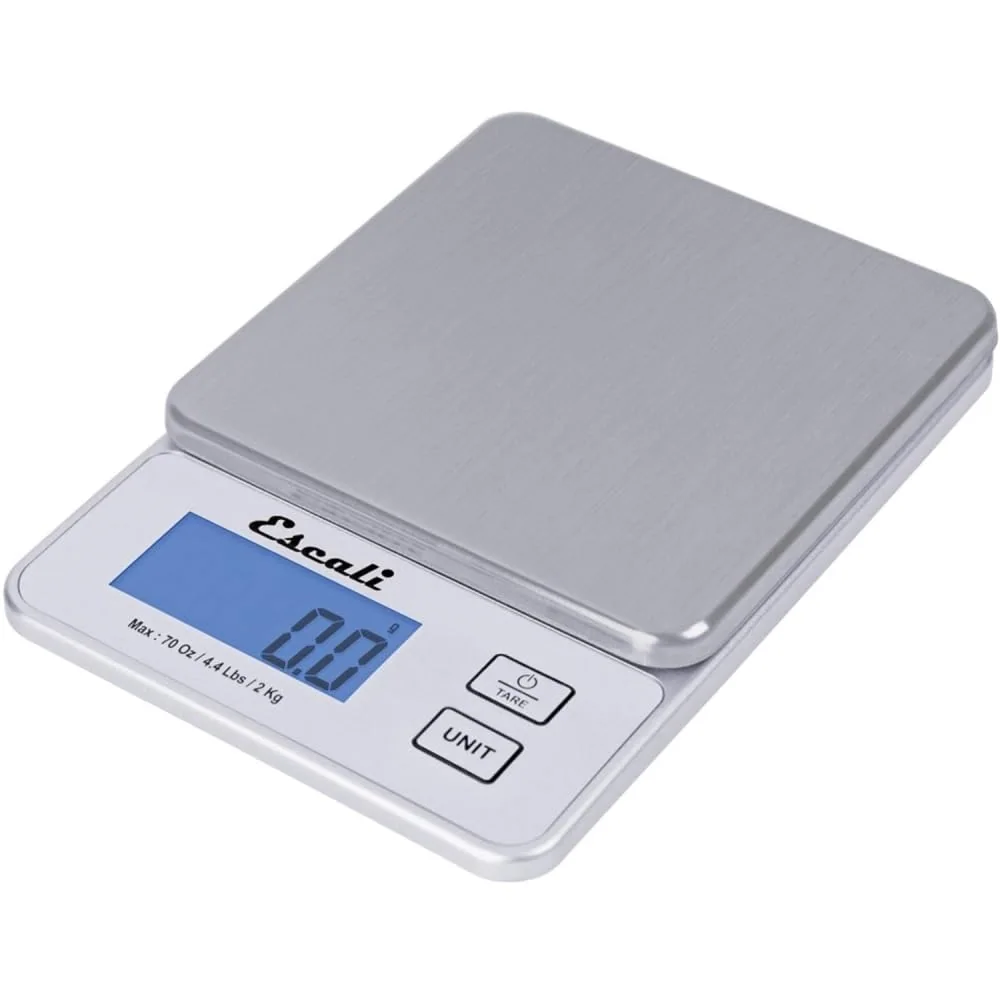
Escali
Escali Vera Gram Scale
Recommended, with caveats4.1 (133 ratings)
- Best for yeast, salt and herbs in small amounts
- Skip it if you weigh heavy bowls or want one scale for everything.
Why weigh at all, and which Escali fits
A kitchen scale turns a vague scoop into a number. Flour packed tight and flour spooned loose fill the same cup with different amounts, and a scale ends the argument. If you bake bread, portion meals or follow recipes written in grams, one decent scale saves batches.
Four Escali scales are on the table here, and they split into three kinds. The Primo is a plain plastic digital with a chrome finish and two buttons. The Arti swaps the buttons for a touch screen under a glass top.
The Mercado is a mechanical dial with no electronics at all. The Vera is a compact digital with a fine readout, and it tops out at 4.4 pounds, well under half of what the others carry.
That ceiling matters more than it sounds. One reviewer of the Arti owns a ceramic mixing bowl that weighs 1,503 g on its own. Put a bowl like that on a small scale and little room is left for food.
So capacity, readout step and how a scale copes with a big bowl are the three things we kept coming back to. You also have to live with the thing. A scale on the counter has to wipe clean, and a scale in a drawer has to be flat and light.
Batteries decide how often you think about it at all. The Primo, the Arti and the Vera need them, and the Mercado does not. We read the four product pages, the brand's descriptions and about thirty buyer reviews, then put the specs side by side.
Escali · digital kitchen scale
Primo: the plain digital that lasts
| Color | Chrome |
|---|---|
| Material | Plastic |
| Weight | 431 g |
| In the box | Food Scale |
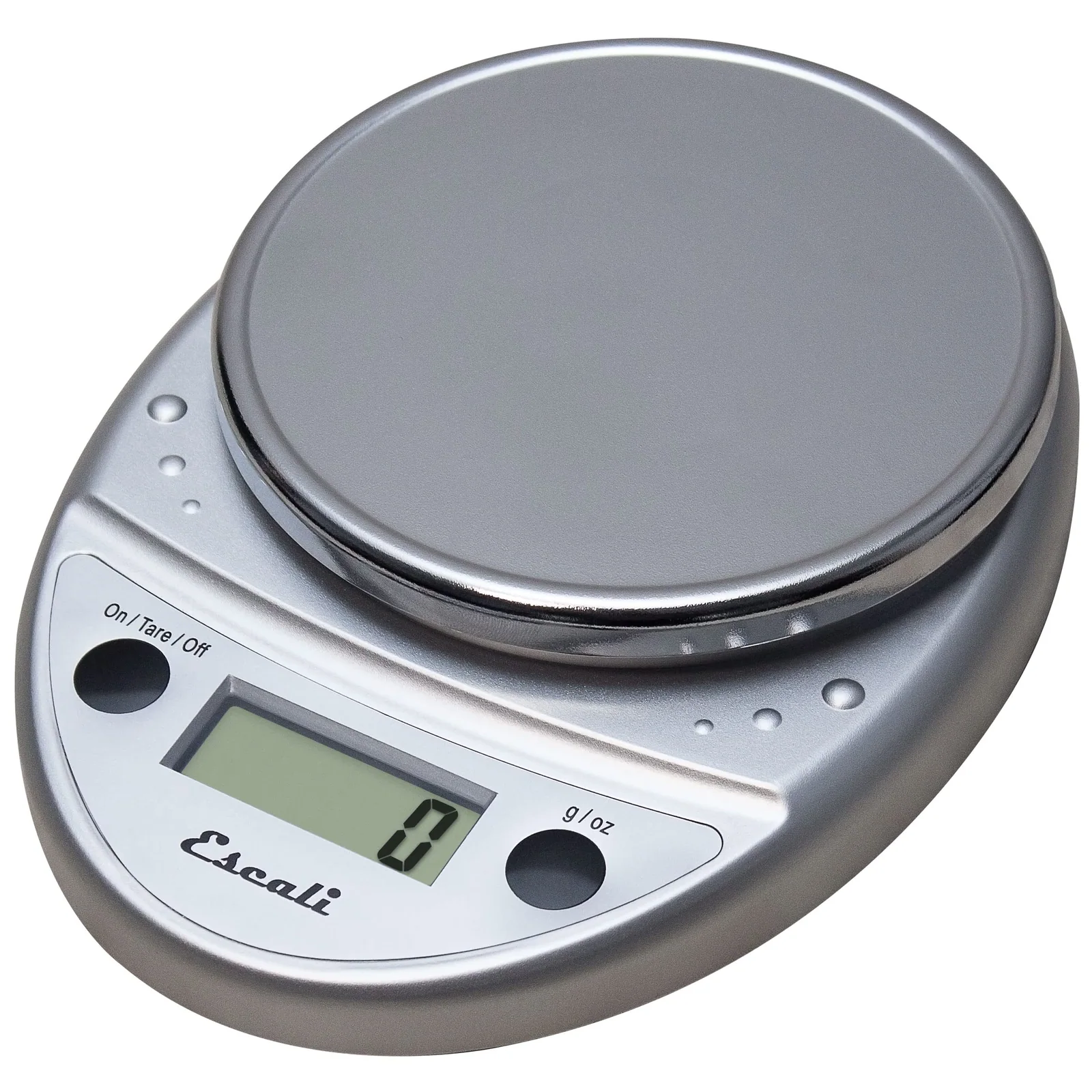
The Primo is the baseline the other three are measured against. It is plastic with a chrome finish, measures 8.5 by 6 by 1.5 inches and weighs 431 g. Two buttons run everything: one switches it on and off and zeros the weight, the other moves between ounces and grams.
Capacity is 11 pounds, or 5,000 g, and the display steps in 1 g or 0.05 oz. That is fine enough for salt and yeast, and coarse enough that you are not chasing flickering digits. The brand says the display and controls sit under a protective shield against spills. Auto shut-off arrives after four minutes of inactivity.
Buyers keep returning to the same few points. The display is quick, the tare responds at once, and the numbers are easy to read with a large bowl on top. One Canadian reviewer has used the same Primo almost every day for close to 15 years.
They wiped it down after spills and bought a second one when a daughter took the first. That is one account, not a guarantee. It does tell you how the scale can age.
The complaints are about size and looks. The weighing area is a disc about 5 1/2 inches across, according to a reviewer who moved over from a larger square scale with a backlight and a pull-out display. On the old one, ingredients went straight on the platform.
It lacks advanced features, but accuracy, speed, and simplicity are its strengths.
On the Primo they sometimes set a plate or bowl down first, then zero it. They still call it accurate and like the lower cost. Another reviewer wished it looked nicer, and a UK reviewer accepted the plastic build as a fair trade for easy cleaning.
Its features list is short: tare, auto shut-off and the sealed panel. The spec sheet shows no hold function and no backlight, so a large bowl will cover the display.
It runs on AA batteries, which the UK reviewer liked more than coin cells. A Canadian reviewer says they last a long time if you switch the scale off between uses.
The brand's copy mentions a lifetime warranty, and the spec field lists five years limited. Read the terms before counting on either.
Buy it if you want one scale for flour, portions and the occasional heavy bowl. Look at the Arti instead if you want a bigger platform or a hold function.
What buyers wrote about the Escali Primo Digital Scale
5 out of 5 Quick, accurate and easy to read, with a reliable tare
I bought the Escali Primo as a straightforward, no nonsense kitchen scale for daily cooking and baking, and it does exactly what it promises. It is light, compact, and quick to respond, with clear readings that are easy to see even when using larger bowls. The controls are minimal but well thought out, with a reliable tare function and simple unit switching between grams and imperial. For portioning ingredients, weighing flour for baking, or general kitchen use, it feels precise and consistent. The build is plastic rather than premium metal, but that keeps it easy to clean and practical for everyday use. It does not feel fragile in normal handling, and the sealed buttons give some reassurance against spills. Using standard AA batteries is also a plus compared to coin cells. It lacks advanced features, but accuracy, speed, and simplicity are its strengths. For the…
4 out of 5 Small footprint, good accuracy
Got this one to replace my Oxo digital and it's a mixed result. The scale itself is accurate and easy to use with one button for one/off and zero the weight, another for grams or ounces. What I like and dislike is the same thing - it's size. The measuring area is a 5 1/2" disc which means this doesn't take up a lot of space on the counter, but the Oxo I used to have was 7 1/2" x 7 1/2" square. The Oxo obviously tool up more space, but it also meant I could just put ingredients directly on the scale, the Escali is a little smaller so sometimes you need to put a plate or bowl on it first. The Oxo also was backlit and had a pull out display if you had a really big bowl. That being said, the Oxo is around $80 and the Escali is around $50 so it's nearly half the cost but still accurate. You won't regret the purchase, but if you're used to something larger, this is a…
Escali · glass-top kitchen scale
Arti: glass top, big bowls, touch controls
| Color | Blue Mirage |
|---|---|
| Material | Glass, Plastic |
| Weight | 1.2 pounds |
| In the box | Scale, Batteries, Owners Manual, Warranty Information |
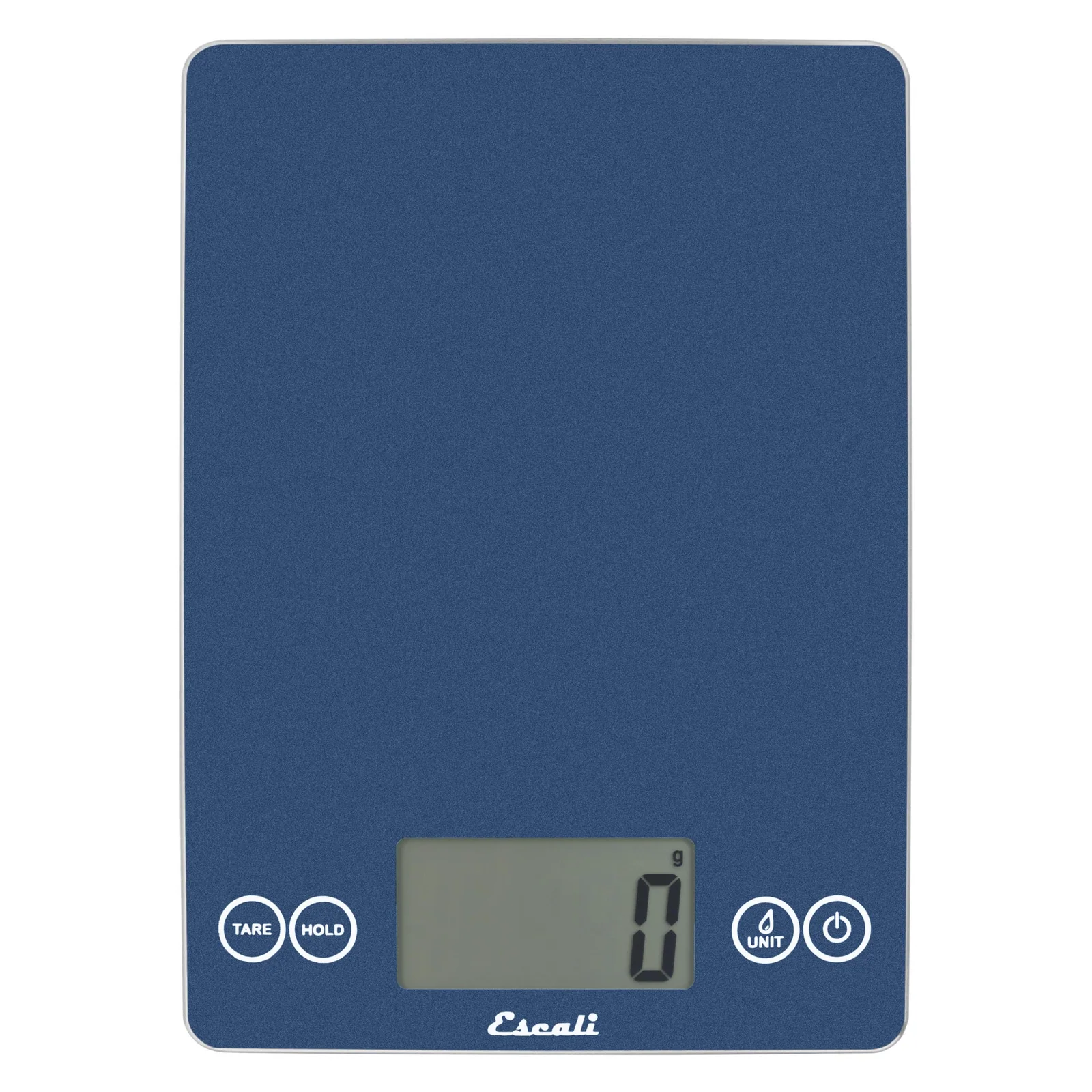
The Arti is the looker of the group. It has a tempered glass top, measures 9 by 6.5 by 0.75 inches and replaces buttons with a touch screen. The brand says that screen is 50 percent larger than on most food scales, and it sells the Arti in 14 metallic colors.
Capacity is 15 pounds, the highest here, with 1 g steps. It reads in grams, pounds, ounces, fluid ounces and milliliters, so liquids are covered as well as dry goods. Two CR2032 coin cells come in the box.
The brand lists a display hold that keeps the reading after you lift the item off, and auto shut-off after five minutes. One reviewer says you switch on the hold, set a very large item down, wait for the beep and the weight stays put.
The glass surface is what bakers will like. One reviewer set a 5-quart mixing bowl on it and could still read the display and reach the controls, because the whole glass surface weighs. Another likes that the platform and control panel are one continuous surface that wipes clean.
A third replaced a 14-year-old Escali digital that had seized up after gunk got inside. They chose the Arti because the top has no gaps.
The drawbacks sit in the details. Touch controls mean a pause.
I'll need to remember to use the rear square section of the scale if I want accurate results.
One reviewer says you wait a few seconds for the tare to set, and another notes that after you press a button the weight shifts before the action runs. Both call it a quirk, not a fault.
A sharper note comes from a 2016 reviewer, who found that the sensor sits slightly toward the back. Their ceramic bowl weighs 1,503 g. Near the center the display read 1,499 to 1,501 g, and over the rear section it read the correct 1,503 g.
Stacks of quarters checked out as accurate when placed that way. That is one report, so treat it as a reason to try your own unit with a known weight, not as a known flaw.
The newest complaint comes from a Canadian reviewer who gave three stars. They have bought this scale for years and used to love it, but a screw on the back now makes changing the battery a chore.
We can't say how many units carry the screw. Coin cells need replacing at some point, so it is not a trivial gripe.
The spec field lists a limited lifetime warranty. Buy the Arti for big bowls, liquids in milliliters and a surface you can wipe in one pass. Skip it if you want the fastest tare or expect to swap batteries often.
What buyers wrote about the Escali Arti Glass Scale
4 out of 5 Almost perfect!
This is a great little scale with an improved design over my 14 year old Escali digital scale that finally seized up from the gunk that had seeped into the innards over the years. The design of my new scales has touch sensitive buttons with no gaps or crevasses on the top surface, preventing this sort of slow electronic death. And the larger display compared to my old Escali scales is also nice. One interesting quirk of this scale is that the weight sensor must be slightly to the rear of the midpoint of the scale. I have an large ceramic mixing bowel that weighs 1503g. If I carelessly put it down near the geometric centre of the scale, I will get a reading of 1499g to 1501g. If I position the bowl over the largest circle that can be made at the back of the weighing platform, I get the correct reading of 1503g. In general, I verified the accuracy of my scale with…
Escali · mechanical dial kitchen scale
Mercado: a spring scale for a retro counter
| Color | Stainless Steel |
|---|---|
| Material | Stainless Steel |
| In the box | Scale |
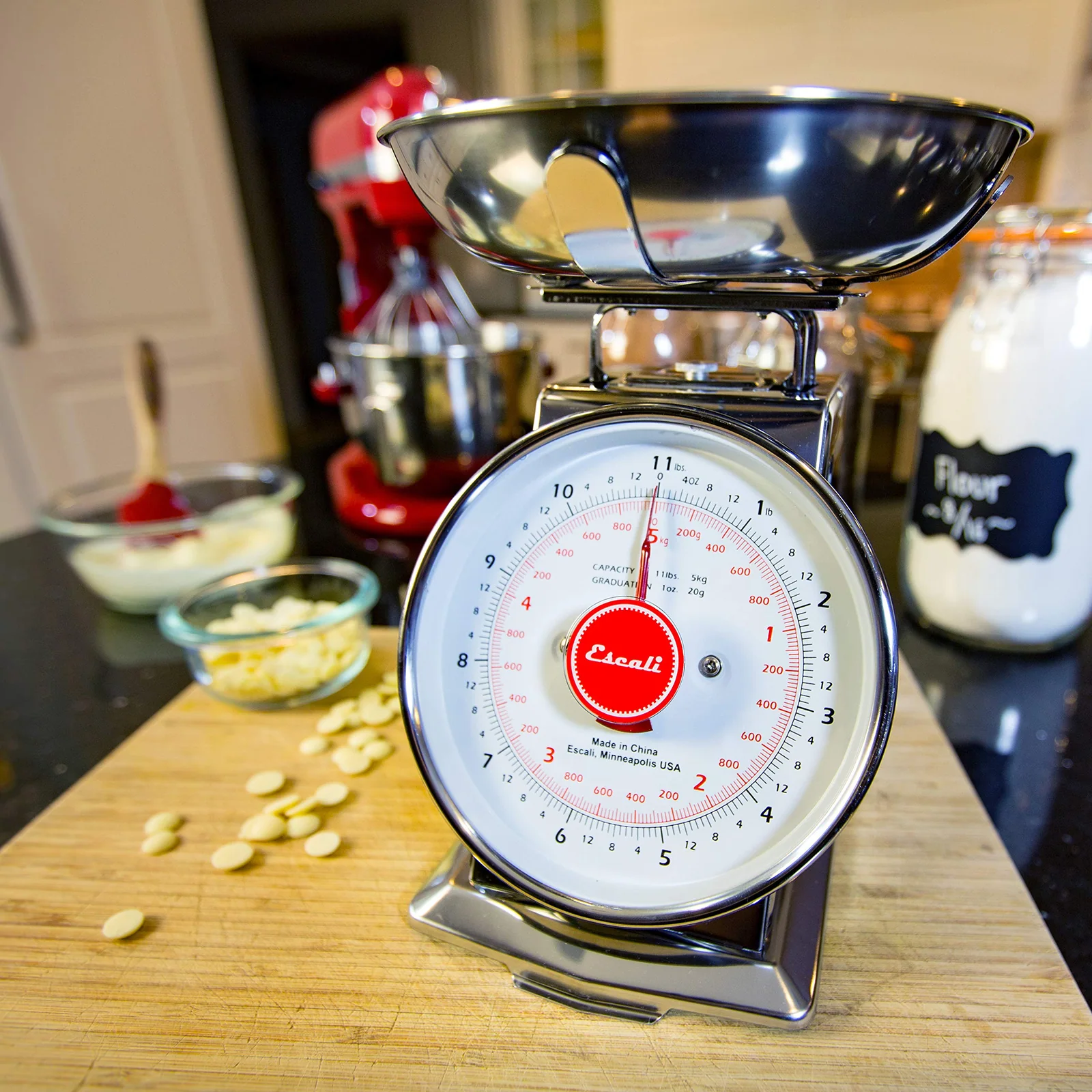
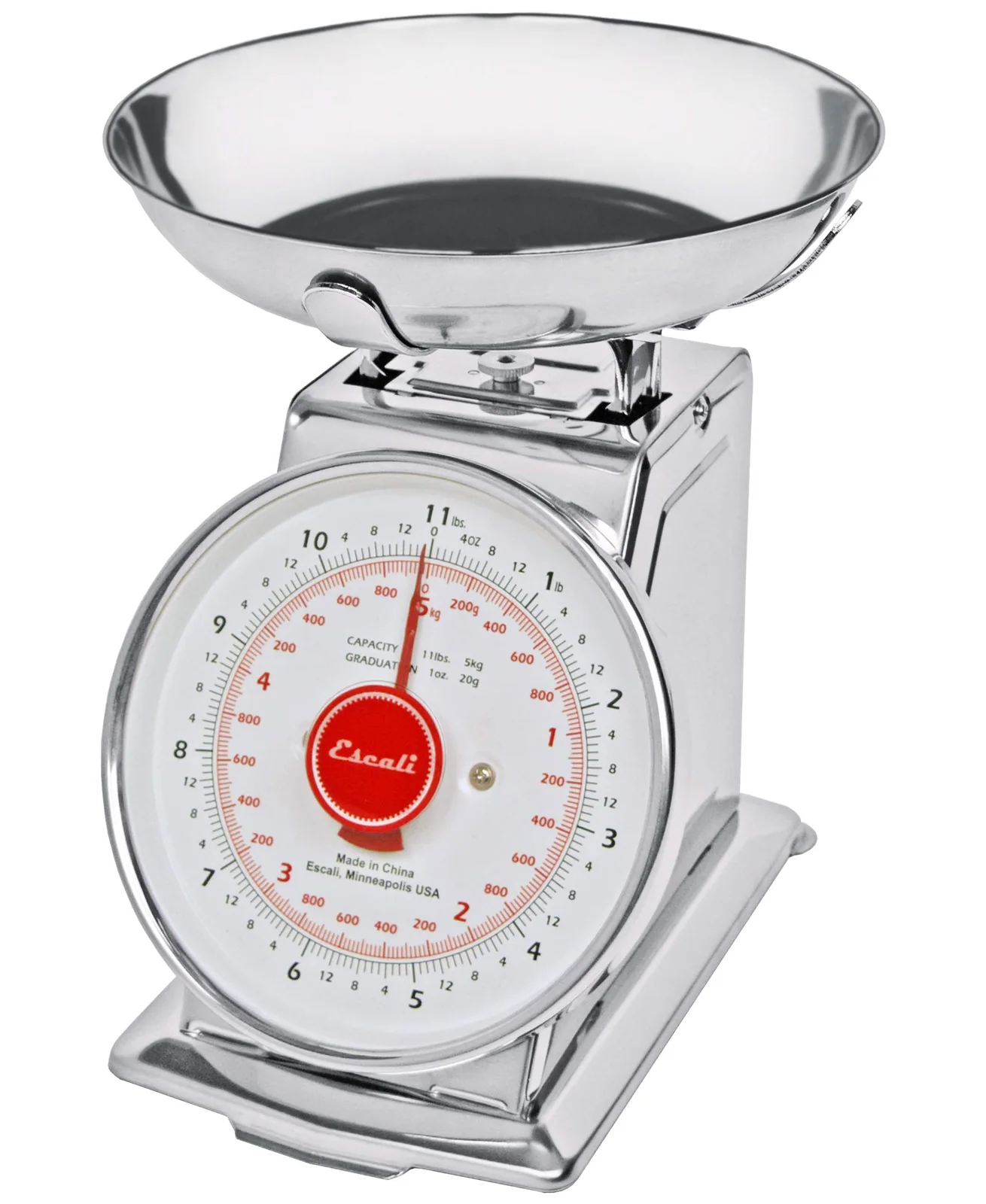
The Mercado is the odd one out. It is a spring scale with a metal frame, a large dial and a removable stainless steel bowl. There are no electronics and no batteries.
The brand says it works without power in a wide range of conditions, which suits a scale that sits in a cupboard between bakes.
Numbers first. Capacity is 11 pounds. The dial reads pounds and ounces on one scale and kilograms and grams on another.
The spec field gives the readout step as 1 oz, so this is a scale for portions and loose recipes, not for 5 g of yeast. The brand calls the dial shatterproof and says the bowl is dishwasher safe. A tare feature lets you reset the scale to zero and weigh several items in one container.
Buyers like the look. Several call it vintage or timeless, and one bought it because they wanted something that looks retro. Accuracy comes up in the good reviews too, and a baker who uses it for bread and other goodies reports no real problems.
There are better and cheaper options available.
The build gets mixed marks. A four-star baker found it a bit too light, with a little bowl that feels unsteady, and wished it felt sturdier. A three-star reviewer called it flimsy and not worth the money, and said better and cheaper options exist.
Another reviewer was happy with the quality and expects it to last. They did find the initial setup complicated, with no instructions in the box.
That split is the story. The brand describes a metal frame, yet a few reviewers feel a light scale. If a heavy, planted feel matters to you, expect something else.
It is rated lower than the Primo on a smaller base of ratings. Nearly three in four ratings are five stars, and about one in ten is a one or two.
Choose the Mercado for a retro counter, batteries you never replace and rough weights. Skip it for fine baking by the gram. Pick the Primo if you want a digital readout at a similar size.
What buyers wrote about the Escali Mercado Dial Scale
3 out of 5 Not Worth The Money
flimsy and not worth the money even though i paid half of what the cost shows today.There are better and cheaper options available.
Escali · high-precision gram scale
Vera: fine readout, small capacity
| Color | Silver |
|---|---|
| Material | Silver-Plated |
| Weight | 8.8 ounces |
| In the box | Scale |
The Vera is the specialist. Capacity is only 4.4 pounds, but the readout is 0.01 oz, the finest on the four spec sheets. The brand sells it for kitchen, baking and herb work, for liquid and dry ingredients alike.
Units are ounces, pounds with ounces, grams, fluid ounces and milliliters. It weighs 8.8 ounces. The plate is removable stainless steel that the brand calls dishwasher safe.
The display is backlit, and the brand calls it easy to read in any environment. The controls sit under a sealed shield against spills, tare resets the weight to zero, and auto shut-off takes five minutes.
Written reviews are thin here. We read four, so lean on the star breakdown: about 59 percent of ratings are five stars and 16 percent are one or two stars. That is the weakest split of the four scales.
One US baker uses it for bread, likes how accurate it is on small amounts such as salt and yeast, and says it takes little counter space. A reviewer in Spain who works in a professional kitchen wished the tray were bigger, but found it enough.
The criticism is sharper than for the other three. One 2016 reviewer put in batteries, saw an error message, and never got a working scale. They called the company, left a message and heard nothing back.
A baker notes the display lags when you add ingredients quickly, so it is easy to overshoot your target. Their advice is to add slowly near the target and let the display catch up.
Customer service gets a better review elsewhere. One reviewer's first Vera failed after three years. A call to the number on the box brought a replacement scale right away, and they kept both.
It is one story, but it shows the support line can come through. The small capacity is the plain limit. A heavy bowl uses up part of the 4.4 pounds before any food goes in, so this is not the scale for a big batch of dough.
Buy the Vera for small amounts: yeast, salt, spices, herbs. Skip it if you weigh heavy bowls, or want a single scale to do everything. Pair it with the Primo or the Arti and the two jobs are covered.
What buyers wrote about the Escali Vera Gram Scale
1 out of 5 Err!!!!!!! Exactly same ...
Err!!!!!!! Exactly same thing happened to me too. I needed the scale asap. I put the batteries and turned it on. It says "Err" This scale doesn't work at all. I called the company right away, they didn't answer so I left a message. I haven't heard anything from them. I am very upset!!!
How the four differ on the numbers
| Feature | Escali Primo Digital Scale | Escali Arti Glass Scale | Escali Mercado Dial Scale | Escali Vera Gram Scale | Also in ToolsEscali DH1 Digital Thermometer |
|---|---|---|---|---|---|
| Price | $25.00 | $34.95 | $34.95 | $31.34 | $21.95 |
| Rating | 4.6 of 5 | 4.3 of 5 | 4.4 of 5 | 4.1 of 5 | 4.3 of 5 |
| Ratings | 7,424 | 1,578 | 418 | 133 | 631 |
| Pieces | 1 Count | 1 Count | 1 Count | 1 Count | 1 Count |
| Best for | everyday baking and portioning on a small counter | bakers who weigh into large mixing bowls | rough portions and a battery-free retro look | yeast, salt and herbs in small amounts | a first thermometer used on roasts and chicken a few times a month |
Capacity splits them first. The Arti carries 15 pounds, the Primo and the Mercado carry 11, and the Vera carries 4.4. If you weigh heavy bowls, that order is your short list.
Readout step splits them second. The Vera reads to 0.01 oz and the Primo to 0.05 oz or 1 g. The Arti reads to 1 g, and the Mercado to 1 oz.
For bread, where a few grams of yeast or salt matter, the Vera and the digital pair do the work. The Mercado does not.
Power is the third split. The Primo takes AA batteries, according to a buyer. The Arti uses two CR2032 coin cells.
A recent reviewer says a screw now holds the Arti's battery door. The Vera takes batteries too, and buyers mention them. The Mercado needs none.
Cleaning differs as well. The Primo and the Vera keep display and controls under a sealed shield. The Arti has one flat glass surface.
The Mercado and the Vera have steel parts the brand calls dishwasher safe, the bowl on one and the plate on the other.
On buyer sentiment, the Primo is ahead: about 80 percent of its ratings are five stars. The Arti sits near 72 percent, the Mercado near 73 percent, and the Vera at 59 percent.
A few points between the Arti and the Mercado mean little. The Vera gap is wide enough to take seriously.
The trade-off is simple. Take the Primo if you want one scale to do most jobs. Take the Arti for large bowls.
Take the Mercado for looks and silence. Take the Vera as a small add-on.
Other ways to measure: when they beat an Escali
Measuring cups are better when a recipe is written in cups and you do not want another gadget on the counter. They never run out of batteries. They lose when accuracy matters, because a cup of flour changes with how you scoop it.
A larger platform scale with a pull-out display is better when you weigh in big bowls. One Primo reviewer missed exactly that after moving from such a scale. The Arti's glass top and hold function are the closest answer in this group, and a larger scale takes up more room, which is the Primo's selling point.
A backlit scale is better in a dim kitchen. Of the four, only the Vera lists a backlight. If you cook late and your kitchen is dark, that detail may matter to you more than capacity.
A mechanical spring scale, such as the Mercado, is better when you hate batteries and like an old-fashioned look. A digital scale is better as soon as you need single grams. The Mercado's 1 oz step makes it a portion tool, not a baking tool.
Glass is better than plastic when wiping matters, because there are no seams where batter can hide. Plastic is better when you want something light that still does the job. The Primo weighs 431 g, light enough to move with one hand.
What buyers say across the four
Escali Primo Digital Scale
4.6 (7,424 ratings)Escali Arti Glass Scale
4.3 (1,578 ratings)Escali Mercado Dial Scale
4.4 (418 ratings)Escali Vera Gram Scale
4.1 (133 ratings)Accuracy is the first word in the good reviews of the Primo, the Arti and the Vera. Buyers say the numbers match what they expect, and they trust them even for small amounts such as yeast and salt. Speed of the display comes next, then footprint: reviewers of three of the four mention counter space as a plus.
Longevity shows up often for the Primo. One reviewer has used theirs close to 15 years, and another reports that it still works after years of baking.
The other scales have shorter stories. A Vera buyer says a first unit failed after three years, and an Arti buyer says an older Escali digital seized up after about 14 years.
The critical reviews are specific. The Primo's is about platform size. The Arti's are about tare pause, a sensor sitting toward the rear, and a screw on the back.
The Mercado's are about feeling light and flimsy. The Vera's are about an error message at startup, a lagging display and a small tray.
The star breakdowns line up with those notes. About 80 percent of the Primo's ratings are five stars and 3 percent are one or two.
The Arti has 72 percent five-star and 12 percent one or two. The Mercado has 73 percent and 9 percent.
The Vera has 59 percent and 16 percent. Written reviews for the Vera were few, so the percentages carry most of the weight there.
The scale can function endlessly without power in a wide range of conditions
Ratings, star breakdowns and “bought in past month” figures were read on the product pages on November 12, 2026.
How to weigh several ingredients into one bowl
All four scales have a tare function, and the idea is the same on each. Zero the display with the bowl in place, so you read only what you add. Then zero again before the next ingredient.
Three notes come from the product pages and reviewers. On the Arti, the display hold keeps the weight on screen after you lift a large item off, and a reviewer says tare takes a few seconds to settle.
A 2016 reviewer found their Arti read correctly with the bowl over the rear section of the platform, so it is worth trying a known weight. On the Vera, a baker advises pouring slowly as you near the target, because the display lags.
The brand's shut-off times differ: four minutes on the Primo, five on the Arti and the Vera. If you pause longer than that between ingredients, the display may go dark and you will need to switch it on and zero it again. The Mercado has no power to run down.
- Set the scale on the counter and switch it on.
- Place the empty bowl on the platform.
- Press tare and wait until the display shows zero.
- Add the first ingredient slowly until you reach the target weight.
- Press tare again to zero the display.
- Add the next ingredient the same way, then switch the scale off.
Which one we would put on the counter
We recommend
Escali Primo Digital Scale
A two-button 11 pound scale with a long record in buyer reviews and few complaints beyond its small platform.
Shop It on AmazonRecommended, with caveats
Escali Arti Glass Scale
The highest capacity here and a wipe-clean surface, held back by a few reports about touch lag, sensor position and battery access.
Shop It on AmazonRecommended, with caveats
Escali Mercado Dial Scale
Looks good and needs no power, but the 1 oz readout and a light build keep it out of serious baking.
Shop It on AmazonRecommended, with caveats
Escali Vera Gram Scale
The finest readout of the four, but a 4.4 pound limit and the weakest star split make it a second scale, not a first.
Shop It on AmazonWe recommend the Primo for most people. It has the strongest star split, a long record in the reviews we read and 11 pounds of capacity. Its small platform is the main compromise, and a plate or bowl solves it.
We would pick the Arti if you bake with big mixing bowls or measure liquids in milliliters. The hold function and the full-surface weighing are real advantages. We would not pick it if a slow tare or an awkward battery door would bother you.
We would pick the Mercado only for its looks and its freedom from batteries. If you plan to weigh by the gram, we don't recommend it. The dial reads in 1 oz steps, and one reviewer called it flimsy and said better, cheaper options exist.
We would pick the Vera as a small second scale for spices, herbs and yeast. We don't recommend it as the only scale in the house. Its limit is 4.4 pounds, its star split is the weakest of the four, and one reviewer got an error message from a new unit.
If you are buying one scale, buy the Primo. If you are buying two, add the Vera for the small stuff or the Arti for the big bowls, depending on which problem you run into more often.
Questions buyers ask
Which is better for baking, the Escali Primo or the Escali Arti?
The Primo is better for most bakers, and the Arti is better for big bowls. The Primo has 11 pounds of capacity, 1 g steps and about 80 percent five-star ratings. The Arti carries 15 pounds, adds a hold function and weighs across its whole glass top, but some reviewers mention a slow tare.
Is the Escali Mercado good for baking?
The Mercado suits rough portions more than baking. Its dial reads in 1 oz steps, so single grams of yeast or salt are out of reach. One baker uses it for bread without problems, but another found it light and the bowl unsteady. For precise recipes, we would use the Primo or the Vera.
What is the best Escali scale for small amounts like yeast and salt?
The Escali Vera has the finest readout of the four, at 0.01 oz, and a baker praises it for salt and yeast. Its limit is 4.4 pounds, so use it for small amounts. A buyer also says the display lags if you add ingredients quickly, so pour slowly near the target.
Which Escali kitchen scale needs no batteries?
The Escali Mercado needs none. It is a mechanical spring scale with a dial, a metal frame and a stainless steel bowl, and the brand says it works without power. The Primo takes AA batteries, according to a buyer, and the Arti uses two CR2032 coin cells.
Can I put the Escali Vera plate or the Mercado bowl in the dishwasher?
Yes, the brand calls both parts dishwasher safe. The Vera has a removable stainless steel plate, and the Mercado has a removable stainless steel bowl. The brand gives no dishwasher rule for the Primo or the Arti, whose buyers describe wiping clean instead.
How long does an Escali Primo scale last?
One Canadian reviewer has used a Primo almost daily for close to 15 years, and another reports it still works after years of baking. These are single accounts, not a promise. The brand's copy mentions a lifetime warranty while the spec field lists five years limited, so check the terms.
Read next
More from Kitchen Tools
Tools · 3 products
Escali Meat Thermometers Compared: Probe, Folding, Wireless
Three Escali thermometers answer three different cooks: the quick check, the rechargeable pocket tool and the long roast you leave alone.
Tools · 5 products
LIVINGO Kitchen Shears Reviewed: Five Pairs and Sets Compared
Five LIVINGO shears, one forged pair that comes apart, and one poultry shear we would pass on: here is what the specs and buyers say.

Tools · 5 products
Silicone, Teak and Ceramic Cooking Utensil Sets Compared
Five ways to fill a utensil drawer, from a 33-piece silicone kit to a pair of ceramic crocks, and who each one suits.