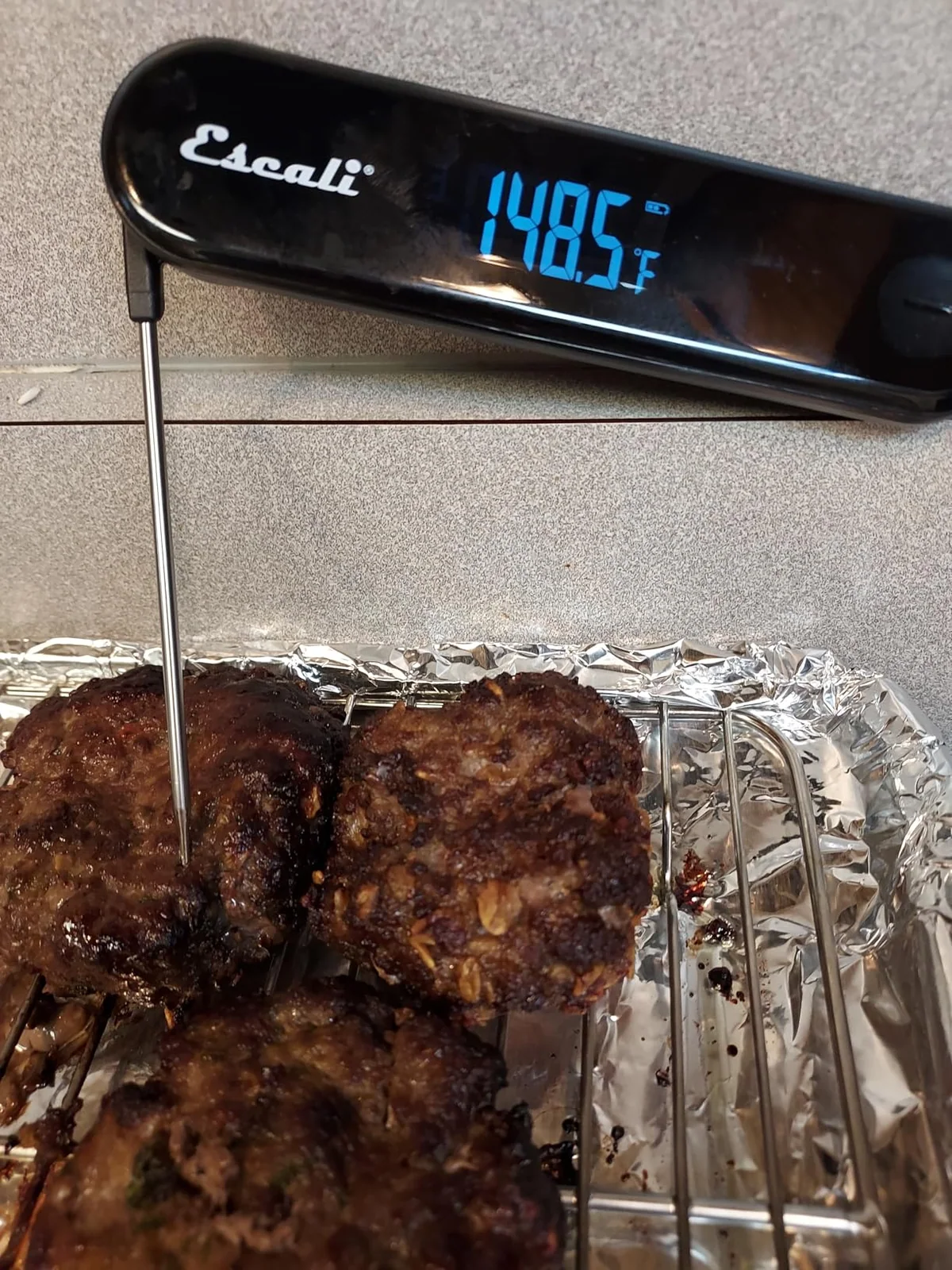
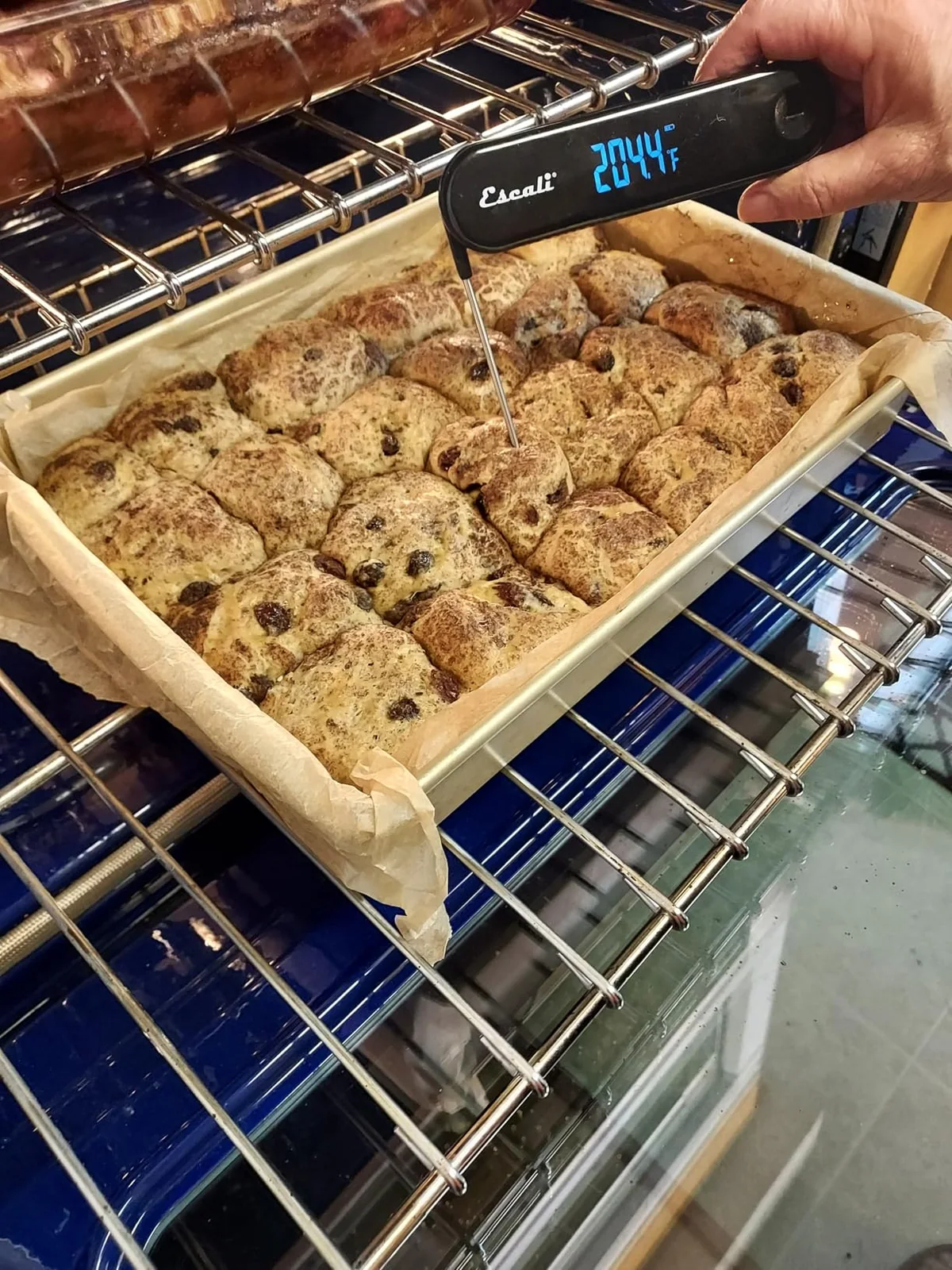
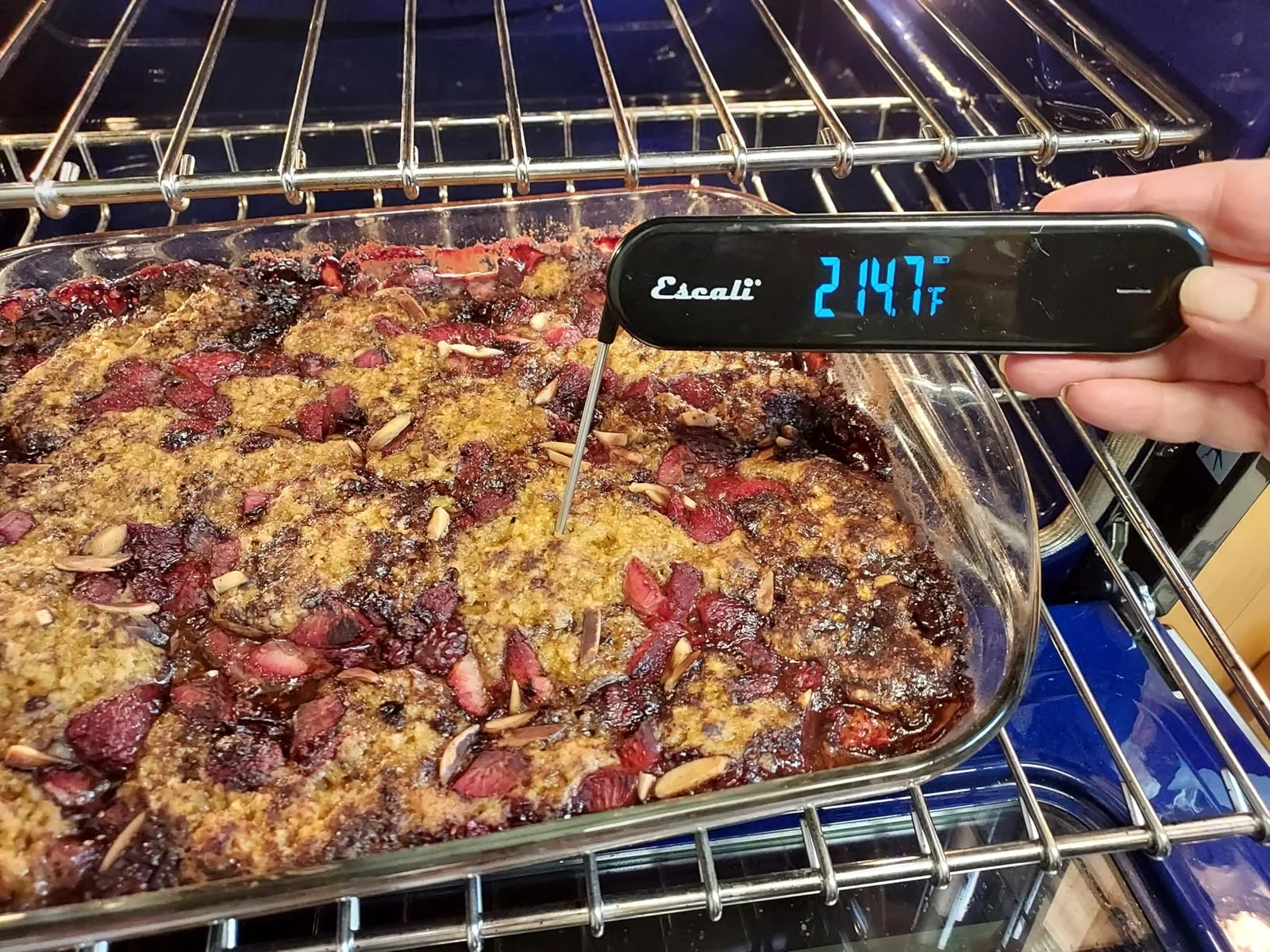
A meat thermometer settles one question: has the middle reached the temperature you need? The USDA Food Safety and Inspection Service says to cook all food to its minimum internal temperature, as measured with a food thermometer, before you take it off the heat.
Color and timing don't meet that line, and neither does a guess from the feel of the meat. Every spec on these three serves that one number.
Escali gives you three ways to take the reading. The DH1 is a classic digital probe at $21.95.
The Stelo is a rechargeable folding model with a thermocouple tip at $69.95. The DHRW1 stays in the food and sends the reading to a display you carry, at $39.99.
The three differ in a way you notice at the stove. The DH1 and the Stelo are for checking: you open the oven, test a roast, a chicken breast or a burger, and pull the probe out.
The DHRW1 is for the long cook, where you want to stay out of the kitchen and still know where the meat stands. A thermometer left in the drawer helps nobody, so how often you will reach for it counts. Which one reads better matters less than which one fits how you cook.
We read all three product pages, the care notes and the buyer reviews, and set the specs side by side. If you cook often and want speed, the Stelo is the one we would reach for first, though its rating rests on only 29 ratings so far. If you want the simple, cheap route, the DH1 is the safer buy.
Escali · digital probe thermometer
DH1: the plain probe that does the job
Escali DH1 Digital ThermometerWe recommend4.3 (631 ratings)$21.95Shop It on Amazon↗
Escali DH1 Digital Thermometer: product photo
Specifications from the product page
Color
Black
In the box
Thermometer, Protective Sheath, Battery
Model
DH1 Gourmet Digital Meat Thermometer with Extra Long Probe, NSF Certified
Weight
2.24 ounces
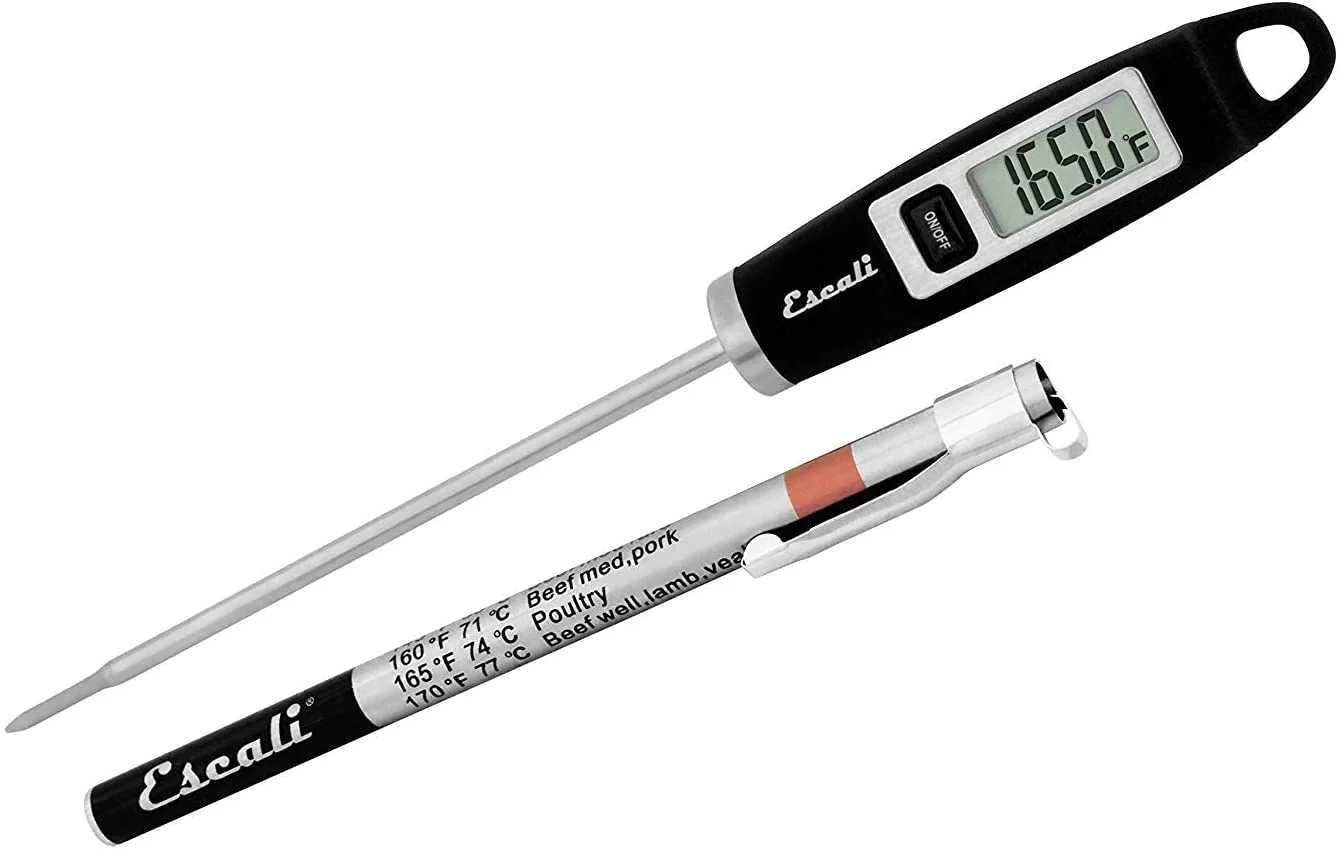
The DH1 is the plainest of the three, and that is its appeal. It is a stainless steel probe thermometer, 8 inches long and 2.24 ounces on Escali's spec sheet, with a comfort grip handle and an extra-long step-down probe. The listed immersion depth is 4.75 inches.
That is the number to hold up against the thickness of what you cook.
The range runs from -49°F to 392°F, which covers every minimum on the USDA chart. The listed response time is 500 milliseconds. It runs on one LR41 button battery, and Escali includes one.
A protective sheath with a pocket clip comes with it. Escali says the sheath carries a reference chart of target temperatures for poultry, beef, pork, lamb and veal.
The product page doesn't print those numbers, so we can't vouch for them. Check them against the USDA figures before you trust them: 165 degrees F for all poultry, 160 for ground meats, and 145 for beef, pork, veal and lamb steaks, chops and roasts, with at least 3 minutes of rest.
The title says NSF certified, and Escali says the manufacturing process is regularly checked by the National Sanitation Foundation. That is a claim about the factory, not a promise about how accurate your unit reads. Care is simple: Escali lists hand wash only.
I like that you permanently set Fahrenheit by the battery rather than accidentally hitting a button on the outside.
Buyer review of the Escali DH1 Digital Thermometer, the United States, December 2, 2019
Buyers like it. It has 631 ratings and averages 4.3 stars, and about 71 percent of the ratings are five stars.
A reviewer in Canada calls it well designed, easy to use and accurate. Another says their second unit has lasted for years. A US reviewer likes that Fahrenheit is set at the battery instead of with an outside button that can get bumped, after once burning food because a different thermometer had been left on Celsius.
The complaints are thin but real. One reviewer in Canada received it in a cut-open package with a missing cap, and the unit didn't work. That reads as a shipping and defect story, not a design flaw, and it is the only written complaint we found.
Still, about 8 percent of ratings are one star and 2 percent are two stars, so a small group is unhappy for reasons we can't see.
Here is what it won't do. The page mentions no hold function, no backlight and no magnet, and it doesn't say the probe folds or that the body is waterproof.
The 392°F ceiling is also the lowest of the three. If you want a rechargeable cell, a folding probe or a hold button, look at the Stelo. If you'd rather not stand at the oven at all, look at the DHRW1.
What buyers wrote about the Escali DH1 Digital Thermometer
5 out of 5Decent for the money
Works great so far. Reads temps fairly quickly. I like that you permanently set Fahrenheit by the battery rather than accidentally hitting a button on the outside. I have burned stuff before (with a different thermometer) not understanding why it wasn’t at temp, just to find it was in Celsius by accident!
1 out of 5Sketchy delivery broken product
thermo arrived with the package cut open and pen cap missing.... to top it off it just doesn't even work. horrible experience don't buy
Escali · rechargeable folding thermometer
Stelo: fast, rechargeable and pricey
Escali Stelo Folding ThermometerRecommended, with caveats4.7 (29 ratings)$69.95Shop It on Amazon↗
Escali Stelo Folding Thermometer: product photo
Specifications from the product page
Color
Black
In the box
Thermometer
Model
Stelo
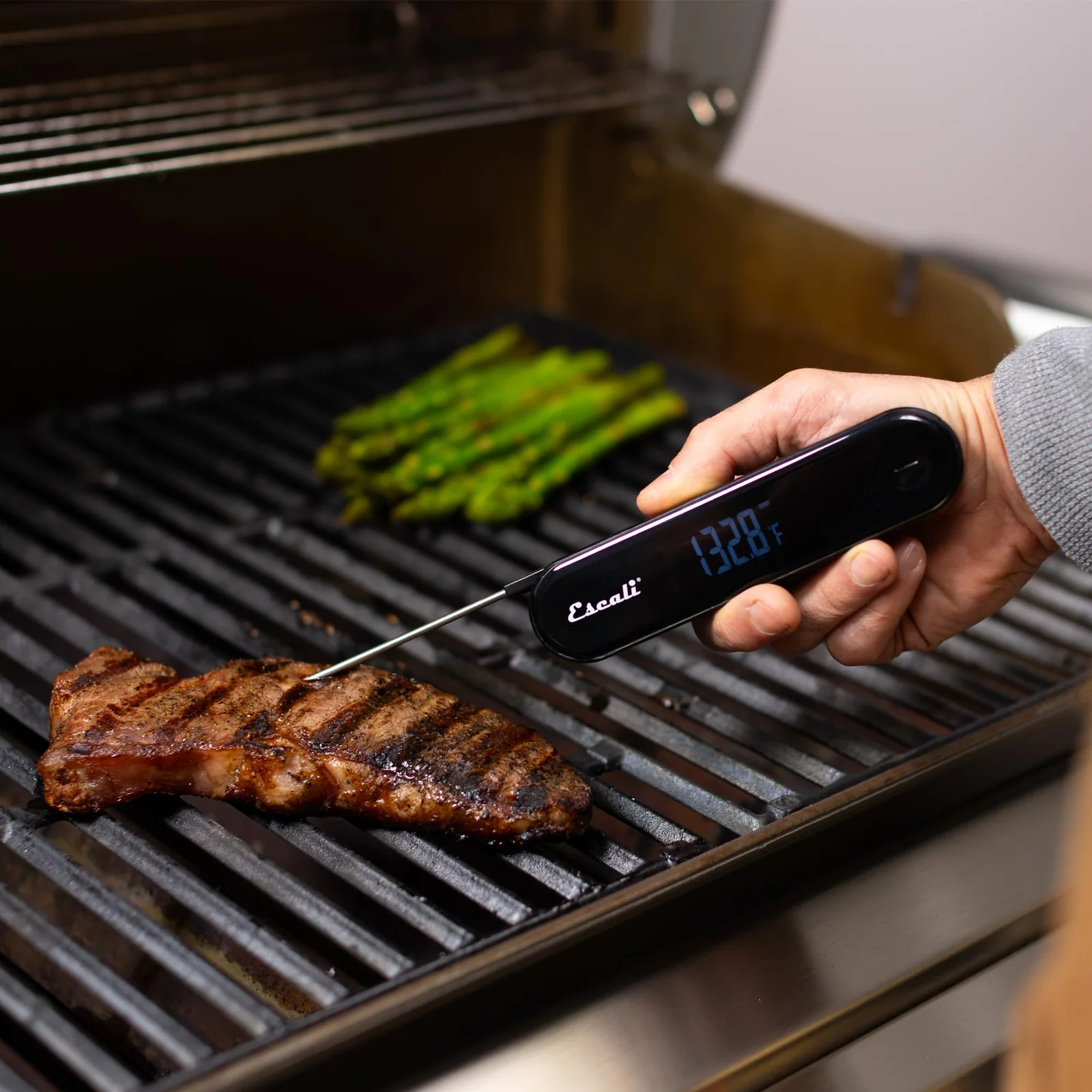
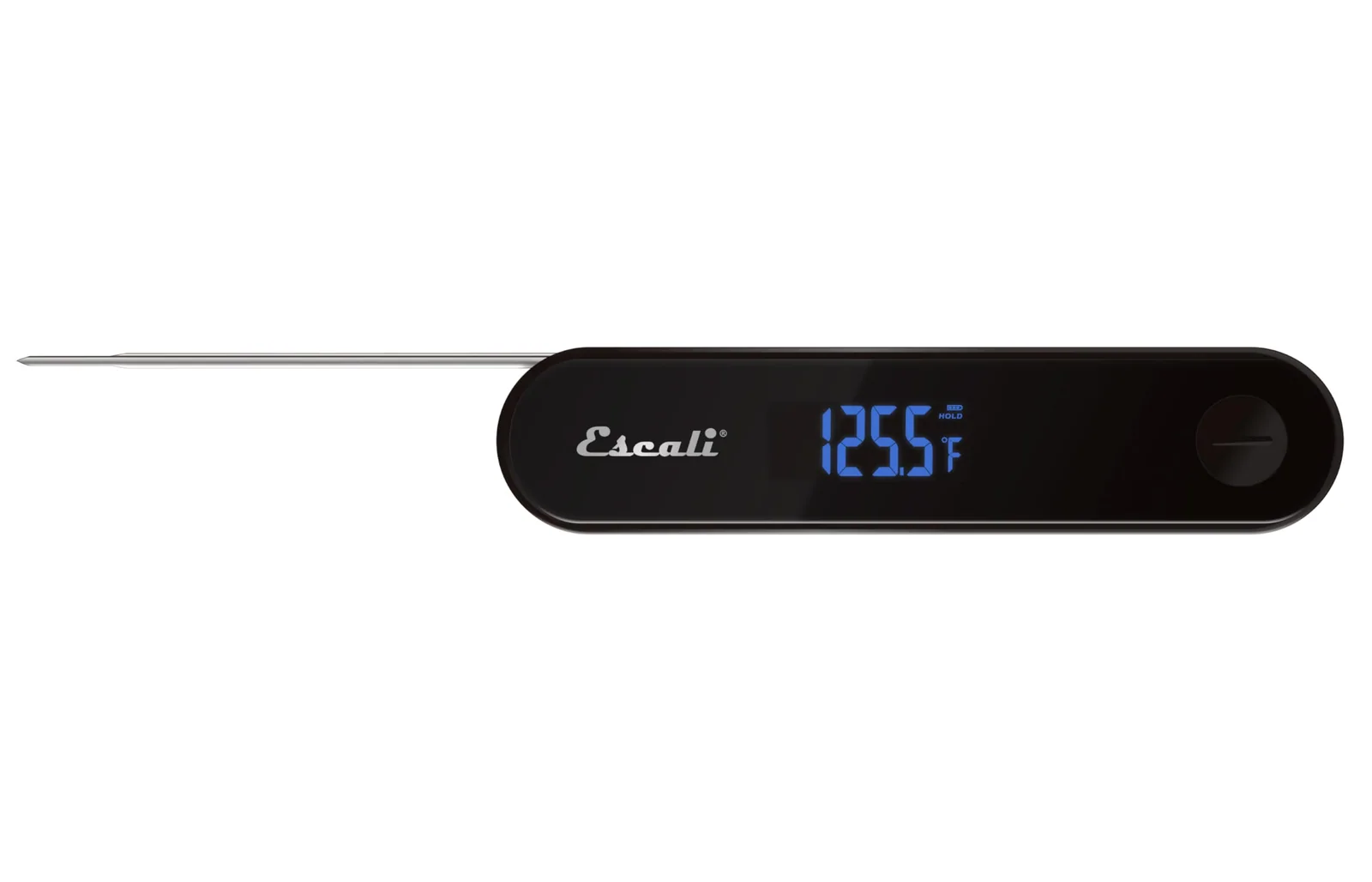
The Stelo is Escali's rechargeable instant-read, and it has the most features of the three. The probe folds into the body, and Escali says it measures at any angle between 45 and 180 degrees. The tip is a 1.6 mm step-down point in stainless steel, while the outer material is listed as plastic.
Escali claims thermocouple technology and readings in under a second. The spec table lists the response time as 1 second, so treat "under a second" as the brand's best case.
One reviewer says it gets close at one second but can still move around a little. Another gives it a few seconds to settle before trusting the number.
The range is -58°F to 572°F. One reviewer says the high ceiling makes it usable for candy. That is a buyer's use, not a claim on the product page.
The handling details are where it pulls ahead of the DH1. The display rotates for left or right hands, the LCD is large and backlit, and a hidden magnet on the back lets it stick to metal.
One reviewer keeps it on the vent hood near the stove. Another owner has the magnet but doesn't attach it to the grill. A hold function locks the reading on screen after you pull the probe out, and a reviewer calls that feature fabulous.
Power comes from a rechargeable lithium-ion cell. One reviewer says a USB C cable is included and that a full charge takes about an hour and then lasts weeks.
the hold function is fabulous, allowing you to take a reading and then keep it displayed after you remove the probe from the food you are testing
Buyer review of the Escali Stelo Folding Thermometer, the United States, May 15, 2025
Another has charged theirs once since buying it. Escali says the cell gives hours of continuous use and that auto-off stretches it.
The drawbacks are specific. A reviewer says it cannot be used while charging, and lists two charging tips: unplug when it is full, and start charging when one bar remains so the cell doesn't run flat. The same reviewer finds it much lighter than an older instant-read and hopes the build isn't flimsy, though it is holding up so far.
With only 29 ratings, there is no long record yet.
Escali rates it IPX7 and calls it waterproof, and one reviewer says the waterproof claims seem correct and that it is easy to clean. The touch-sensitive button, per Escali, is meant to make cleaning easy.
It costs $69.95, well above the DH1. About 76 percent of ratings are five stars and none are one or two stars, but that is a small crowd.
Skip it if you want a probe that stays in the meat, because this is a check-and-pull-out tool. Skip it too if the price is a stretch, since the DH1 covers the basics.
What buyers wrote about the Escali Stelo Folding Thermometer
4 out of 5Works well, hope it is not flimsy
It has a temperature range of -58 to 572 °F (or -50 to 300 °C ). The high upper range means that it can be used safely for candy (at 351°F you have reached the "oops" stage of burnt sugar, which is probably the highest internal temperature measurement for any food). From my tests and comparisons with my other thermometers, this one is accurate; although I do give it a few seconds to stabilize. It seems to be much lighter in weight than my other instant-read thermometer - I do hope this is not indicative of flimsy construction. Advances in technology could account for the weight difference. So far it is holding up well, but if it turns out to be not durable, I shall update this review. It cannot be used while charging. There are two recommendations regarding charging, to prevent damage: 1) unplug once it is fully charged, and 2) start charging when one bar remains, so…
Customer photo via Amazon reviewCustomer photo via Amazon reviewCustomer photo via Amazon review
5 out of 5A Great Thermometer
This is the instant-read thermometer I've been waiting for. I have had a few of these over the years, but they all required a battery and this one, being rechargeable, is just what I have been looking for. The readout is nice and large, and the hold function is fabulous, allowing you to take a reading and then keep it displayed after you remove the probe from the food you are testing. The fold-able probe is a nice touch, allowing you to test at any angle. It's also got a magnetic back which allows me to store it on my vent hood, right near where I need to use it. I've charged mine once since I purchased it, so it seems to hold a charge for a long time. I love this unit and I think you will too.
Escali · wireless meat thermometer
DHRW1: leave the probe in, walk away
Escali DHRW1 Wireless ThermometerRecommended, with caveats4.2 (120 ratings)$39.99Shop It on Amazon↗
Escali DHRW1 Wireless Thermometer: product photo
Specifications from the product page
Color
Black/Silver
In the box
Thermometer Display^Base^Probe^ Batteries
Model
DHRW1
Weight
6.4 ounces
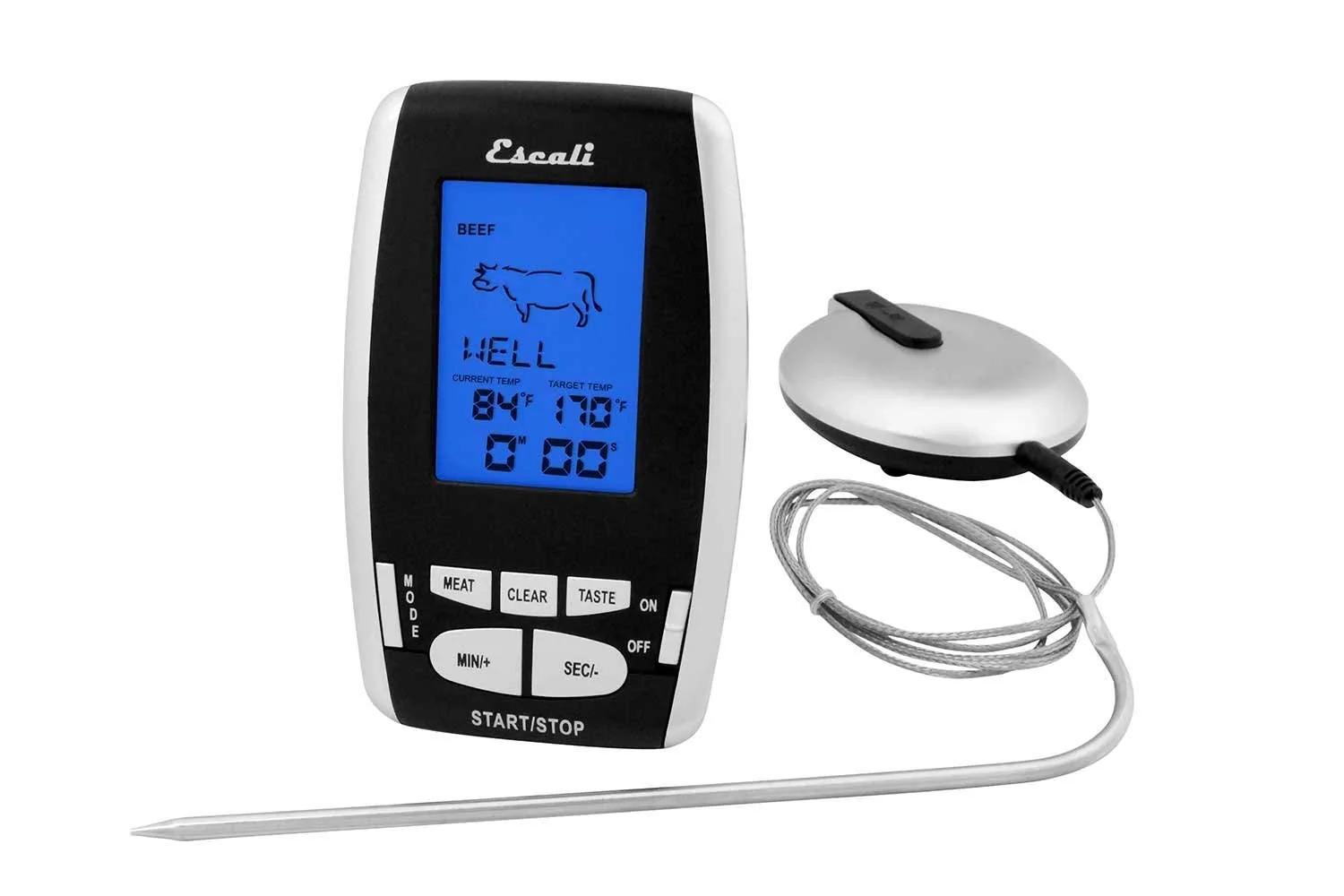
The DHRW1 works differently from the other two. The probe stays in the food, the display travels with you, and a timer sits beside the temperature. Escali lists a 7.25 inch probe on a 40-inch oven-safe cord, and the included components are the display, a base, the probe and batteries.
The range is 32°F to 482°F with a 0.1 degree resolution. The timer runs to 99 minutes and 59 seconds.
Power comes from four AAA batteries, and Escali includes them. The unit weighs 6.4 ounces by the spec sheet.
Escali says the display has a pocket or belt clip and a built-in kickstand for the counter. It lists a wireless range of 200 feet.
It also says target temperatures for beef, lamb, veal, hamburger, pork, turkey, chicken and fish are stored in the unit. The page doesn't say which numbers those are, so check them against the USDA chart before relying on them.
Range is the weak point in the one detailed review. A reviewer who used it for just over a year, in the oven and on the grill, says meat always came out right.
Have found that if there are obstructions, like walls, receiving range is considerably shorter.
Buyer review of the Escali DHRW1 Wireless Thermometer, the United States, August 10, 2023
Walls and other obstructions cut the receiving range a lot, though, and the reviewer says that doesn't spoil its usefulness. Plan on the 200 feet working in open air, not through a house.
Escali lists indoor use and says to wipe it clean. Escali gives a 2 year product and parts warranty, which is the only written warranty term across the three pages. If a buyer wants backing past the first few months, that counts for something.
The written reviews are few. Only two turned up, both five stars. One calls it easy to use with a long-distance remote and well worth the money.
With 120 ratings at 4.2 stars, about 67 percent are five stars, 10 percent are one star and 2 percent are two stars. Nobody wrote down why the low ratings were given, so we can't say what goes wrong.
One spec deserves a note. The listed range starts at exactly 32°F, which is the ice-water number USDA gives for a calibrated thermometer. The page doesn't say how it reads right at the edge of its range, so for this one we would lean on the boiling-water check, which the USDA also describes.
It suits the cook who wants to roast a cut, set the timer and stay in the next room. It doesn't suit a quick spot check, since you have to place the probe before the cook starts. For that, take the DH1 or the Stelo.
What buyers wrote about the Escali DHRW1 Wireless Thermometer
5 out of 5Works Real Good
Have used for just over a year, both in oven and grill. Meat is always just right. Says it has a 200 foot range. Have found that if there are obstructions, like walls, receiving range is considerably shorter. However, that doesn't diminish the utility of thermometer.
a first thermometer used on roasts and chicken a few times a month
cooks who check meat often and want a hold button and magnet
slow roasts and long grill sessions when you want to leave the room
everyday baking and portioning on a small counter
bakers who weigh into large mixing bowls
The ranges are the first split. The Stelo reads from -58°F to 572°F, the DH1 from -49°F to 392°F, and the DHRW1 from 32°F to 482°F. Every minimum on the USDA chart sits inside all three ranges, so the extra ceiling only matters for work above 482°F, like the candy use one Stelo reviewer mentions.
Speed is closer than the marketing suggests. The DH1 lists 500 milliseconds and the DHRW1 lists 0.5 seconds.
The Stelo claims under a second but lists 1 second in its spec table. Reviewers describe the Stelo as close to instant, and we have no figure that puts it ahead of the others.
Power and care separate them. The DH1 runs on one LR41 button battery and is hand wash only. The Stelo recharges and is rated IPX7.
The DHRW1 takes four AAA batteries and wipes clean. Only the DHRW1 gives a written warranty term, 2 years.
The real difference is how you hold the cook. The DH1 and the Stelo are check tools you pull out. The DHRW1 stays in with a 40-inch cord and a display that goes 200 feet in the open.
If you need both jobs, the cheapest pairing is the DH1 and the DHRW1. If you cook mostly at the stove and want a hold button, the Stelo alone does the work.
When another type of thermometer is the better buy
A deep-frying and candy thermometer is the better buy for oil and sugar. Escali sells one with a pot clip and a 12-inch probe, which is a different shape from a meat probe. See the candy, fridge and timer gear if your cooking leans that way.
A kitchen timer is the better buy for sequencing a dinner. The DHRW1 already carries a timer, but if you use the DH1 or the Stelo, a separate four-event timer with a magnetic back keeps several dishes straight.
A fridge and freezer thermometer is a different job entirely. It hangs or stands inside the cold box and has nothing to do with checking a roast. Buy one for the fridge and don't ask a meat probe to do it.
A clock is not a substitute. The USDA chart is written around readings taken with a food thermometer, so a timer alone can't tell you the meat has reached its minimum. If the thermometer is the question, the only real alternatives are the other two Escali models.
A bluetooth thermometer is another type, and one Stelo reviewer owns one. It is a tool to look at if the DHRW1's range through walls is a problem. We have no spec sheet to compare it against, so we won't rank it.
What buyers say about all three
Escali DH1 Digital Thermometer
4.3 (631 ratings)
5 star71%
4 star13%
3 star6%
2 star2%
1 star8%
Escali Stelo Folding Thermometer
4.7 (29 ratings)
5 star76%
4 star16%
3 star8%
2 star0%
1 star0%
Escali DHRW1 Wireless Thermometer
4.2 (120 ratings)
5 star67%
4 star15%
3 star6%
2 star2%
1 star10%
Reviewers agree on a few things. Accuracy comes up for the DH1 and the Stelo, and speed comes up for the Stelo. The Stelo's hold function, magnetic back and rechargeable cell get the most unprompted praise, and one reviewer calls the rechargeable cell the thing they had been waiting for.
The star breakdowns tell the same story. About 71 percent of the DH1's ratings are five stars, about 76 percent of the Stelo's, and about 67 percent of the DHRW1's. The DH1 has 8 percent one-star ratings, the DHRW1 has 10 percent, and the Stelo has none.
The Stelo's sample is the smallest, with 29 ratings, so that clean sheet is thin evidence.
The complaints are few and specific. The DH1 has one written complaint, about a unit that arrived damaged and dead. The Stelo's reviewers mention that it can't be used while charging, that it needs a few seconds to settle and that the body feels light.
The DHRW1's one caution is range: obstructions like walls shrink it a lot. Negative written reviews were scarce across all three, so the one-star ratings mostly lack an explanation.
Ratings, star breakdowns and “bought in past month” figures were read on the product pages on November 12, 2026.
How to check your thermometer before you trust it
Any of these three is only as good as its reading. The USDA Food Safety and Inspection Service describes calibration as the process of checking the accuracy of a food thermometer, and it gives two ways to do it: one with ice water and one with boiling water.
In the ice-water check, the USDA says the thermometer should read 32 degrees F, and if it does, it is calibrated. In the boiling-water check, it should read 212 degrees F at sea level. Altitude changes that number, and the USDA quote we have only gives the sea-level figure.
The quotes we read don't say how to adjust a unit that misses, and none of the three product pages describes a way to recalibrate. A thermometer that misses the mark is a thermometer to return or replace.
Once it passes, cook to the USDA minimums and measure before you take the food off the heat.
Pick a calibration method: ice water or boiling water.
Check that the thermometer reads 32 degrees F in ice water, the USDA figure.
Check that it reads 212 degrees F in boiling water at sea level.
Return or replace a thermometer that misses these numbers.
Measure with the thermometer before you remove the food from the heat.
Cook to the USDA minimums: 165 degrees F for poultry, 160 for ground meats and 145 for steaks, chops, roasts and fish.
Which one we would buy
We recommend
Escali DH1 Digital Thermometer
It is the cheapest of the three, has a long probe and a clear spec sheet, and only one written complaint turned up.
We recommend the DH1 to anyone who wants a thermometer they will actually use and doesn't want to pay much. It has a long probe, a clear spec sheet and one written complaint among the few reviews we read. Pair it with the USDA chart, not the one in the sheath, until you have checked the sheath chart's numbers yourself.
We recommend the Stelo with a condition. If you check meat several times a week and like a hold function and a magnet, it is the most pleasant of the three. But a plastic body, a charging rule and only 29 ratings are fair reasons to wait or to buy the cheaper DH1 first.
We recommend the DHRW1 only for long cooks. Its 40-inch oven-safe cord, timer and 2 year warranty make sense for roasts and grill sessions. We don't recommend it if walls sit between you and the cooker, because a reviewer says the range drops a lot there.
We also don't recommend it as your only thermometer, since you can't spot check with it the way you can with the others.
If we could keep only one, it would be the Stelo, and if the budget says otherwise, the DH1. The DHRW1 is the one to add when you start cooking roasts you want to leave alone.
Questions buyers ask
Which is better, the Escali Stelo or the DH1?
The Stelo is better for frequent checking, with a hold function, a backlit screen, a magnet and a rechargeable cell. The DH1 is better for value, at less than a third of the price. Both read fast on paper, at 1 second for the Stelo and 500 milliseconds for the DH1, so speed shouldn't decide it.
Is the Escali DHRW1 good for slow roasts?
Yes, that is the job it was built for. Escali lists a 40-inch oven-safe cord and a 99 minute, 59 second timer, and one reviewer used it for over a year in the oven and on the grill. Walls cut its 200-foot range a lot, so keep a clear line to the display.
What temperature should chicken reach?
The USDA Food Safety and Inspection Service lists 165 degrees F for all poultry, including breasts, whole birds, legs, thighs, wings and ground poultry. It says to cook all food to its minimum internal temperature, as measured with a food thermometer, before removing it from the heat.
How do I check that my meat thermometer is accurate?
The USDA describes two ways: ice water and boiling water. In ice water the thermometer should read 32 degrees F, and in boiling water it should read 212 degrees F at sea level. If it reads right, the USDA says it is calibrated.
Can I leave the Escali DH1 in the oven?
Escali's page for the DH1 gives no oven-safe rule, so we wouldn't. The brand calls the DHRW1's probe and 40-inch cord oven safe, and that is the model built to stay in the food. The DH1 and the Stelo are made for checking and pulling out.
How long does the Escali Stelo battery last?
Escali says the lithium-ion cell gives hours of continuous use. One reviewer says a full charge takes about an hour and then lasts weeks, and another has charged theirs only once since buying it. One reviewer also says it can't be used while charging.
Sources
This review covers food safety. It is general information, not professional advice: follow the agency guidance and your appliance's manual.